This change spreads Chatwoot Hub version checks across the day by
scheduling each installation at a stable minute derived from its
installation identifier, instead of having all instances check at the
same fixed time.

Closes
-
https://linear.app/chatwoot/issue/CW-6107/handle-the-spike-at-12-utc-on-chatwoot-hub

What changed
- Added `Internal::TriggerDailyScheduledItemsJob` to act as the daily
trigger for deferred internal jobs.
- Updated the version check cron entry to run once daily at `00:00 UTC`
and enqueue the actual version check for that installation’s assigned
minute of the day.
- Used a deterministic minute-of-day derived from
`ChatwootHub.installation_identifier` so the check time stays stable
across deploys and restarts.
- Kept the existing cron schedule key while switching it to the new
orchestrator job.

How to test
- Run `bundle exec rspec
spec/jobs/internal/check_new_versions_job_spec.rb
spec/jobs/internal/trigger_daily_scheduled_items_job_spec.rb
spec/configs/schedule_spec.rb`
- In a Rails console, run
`Internal::TriggerDailyScheduledItemsJob.perform_now` and verify
`Internal::CheckNewVersionsJob` is enqueued with a `wait_until` later
the same UTC day.
- In Super Admin settings, use Refresh and verify the version check
still runs immediately.

---------

Co-authored-by: Sojan Jose <sojan@pepalo.com>
This fixes the agent-bot webhook delivery path so transient upstream
failures follow the expected delivery lifecycle. Existing fallback
behavior is preserved, and fallback actions are applied only after
delivery attempts are exhausted.

To reproduce, configure an agent-bot webhook endpoint to return 429/500
for message events. Before this fix, failure handling could be applied
too early; after this fix, delivery attempts complete first and then
existing fallback handling runs.

Tested with:
- bundle exec rspec spec/jobs/agent_bots/webhook_job_spec.rb
spec/lib/webhooks/trigger_spec.rb
- bundle exec rubocop spec/jobs/agent_bots/webhook_job_spec.rb
spec/lib/webhooks/trigger_spec.rb

---------

Co-authored-by: Muhsin Keloth <muhsinkeramam@gmail.com>
## Notion document

https://www.notion.so/chatwoot/Email-IMAP-Issue-30aa5f274c928062aa6bddc2e5877a63?showMoveTo=true&saveParent=true

## Description

PLAIN IMAP channels (non-OAuth) were silently retrying failed
authentication every minute, forever. When credentials are
wrong/expired, Net::IMAP::NoResponseError was caught and logged but
channel.authorization_error! was never called — so the Redis error
counter never incremented, reauthorization_required? was never set, and
admins were never notified. OAuth channels already had this handled
correctly via the Reauthorizable concern.
Additionally, Net::IMAP::ResponseParseError (raised by non-RFC-compliant
IMAP servers) was falling through to the StandardError catch-all,
flooding
Estimated impact before fix: ~70–75 broken IMAP inboxes generating
~700k–750k wasted Sidekiq jobs/week.

## Type of change

- [ ] Bug fix (non-breaking change which fixes an issue)

## Checklist:

- [ ] My code follows the style guidelines of this project
- [ ] I have performed a self-review of my code
- [ ] I have commented on my code, particularly in hard-to-understand
areas
- [ ] I have made corresponding changes to the documentation
- [ ] My changes generate no new warnings
- [ ] I have added tests that prove my fix is effective or that my
feature works
- [ ] New and existing unit tests pass locally with my changes
- [ ] Any dependent changes have been merged and published in downstream
modules
## Linear Ticket:
https://linear.app/chatwoot/issue/CW-6081/review-feedback

## Description

Assignment V2 Service Enhancements

- Enable Assignment V2 on plan upgrade
- Fix UI issue with fair distribution policy display
- Add advanced assignment feature flag and enhance Assignment V2
capabilities

## Type of change

- [ ] Bug fix (non-breaking change which fixes an issue)

## How Has This Been Tested?

This has been tested using the UI.

## Checklist:

- [ ] My code follows the style guidelines of this project
- [ ] I have performed a self-review of my code
- [ ] I have commented on my code, particularly in hard-to-understand
areas
- [ ] I have made corresponding changes to the documentation
- [ ] My changes generate no new warnings
- [ ] I have added tests that prove my fix is effective or that my
feature works
- [ ] New and existing unit tests pass locally with my changes
- [ ] Any dependent changes have been merged and published in downstream
modules

<!-- CURSOR_SUMMARY -->
---

> [!NOTE]
> **Medium Risk**
> Changes auto-assignment execution paths, rate limiting defaults, and
feature-flag gating (including premium plan behavior), which could
affect which conversations get assigned and when. UI rewires inbox
settings and policy flows, so regressions are possible around
navigation/linking and feature visibility.
>
> **Overview**
> **Adds a new premium `advanced_assignment` feature flag** and uses it
to gate capacity/balanced assignment features in the UI (sidebar entry,
settings routes, assignment-policy landing cards) and backend
(Enterprise balanced selector + capacity filtering).
`advanced_assignment` is marked premium, included in Business plan
entitlements, and auto-synced in Enterprise accounts when
`assignment_v2` is toggled.
>
> **Improves Assignment V2 policy UX** by adding an inbox-level
“Conversation Assignment” section (behind `assignment_v2`) that can
link/unlink an assignment policy, navigate to create/edit policy flows
with `inboxId` query context, and show an inbox-link prompt after
creating a policy. The policy form now defaults to enabled, disables the
`balanced` option with a premium badge/message when unavailable, and
inbox lists support click-to-navigate.
>
> **Tightens/adjusts auto-assignment behavior**: bulk assignment now
requires `inbox.enable_auto_assignment?`, conversation ordering uses the
attached `assignment_policy` priority, and rate limiting uses
`assignment_policy` config with an infinite default limit while still
tracking assignments. Tests and i18n strings are updated accordingly.
>
> <sup>Written by [Cursor
Bugbot](https://cursor.com/dashboard?tab=bugbot) for commit
23bc03bf75ee4376071e4d7fc7cd564c601d33d7. This will update automatically
on new commits. Configure
[here](https://cursor.com/dashboard?tab=bugbot).</sup>
<!-- /CURSOR_SUMMARY -->

---------

Co-authored-by: Pranav <pranav@chatwoot.com>
Co-authored-by: iamsivin <iamsivin@gmail.com>
Co-authored-by: Muhsin Keloth <muhsinkeramam@gmail.com>
Co-authored-by: Shivam Mishra <scm.mymail@gmail.com>
Upgrade rails to 7.2.2 so that we can proceed with the rails 8 upgrade
afterwards

 # Changelog
- `.circleci/config.yml` — align CI DB setup with GitHub Actions
(`db:create` + `db:schema:load`) to avoid trigger-dependent prep steps.
- `.rubocop.yml` — add `rubocop-rspec_rails` and disable new cops that
don't match existing spec style.
- `AGENTS.md` — document that specs should run without `.env` (rename
temporarily when present).
- `Gemfile` — upgrade to Rails 7.2, switch Azure storage gem, pin
`commonmarker`, bump `sidekiq-cron`, add `rubocop-rspec_rails`, and
relax some gem pins.
- `Gemfile.lock` — dependency lockfile updates from the Rails 7.2 and
gem changes.
- `app/controllers/api/v1/accounts/integrations/linear_controller.rb` —
stringify params before passing to the Linear service to keep key types
stable.
- `app/controllers/super_admin/instance_statuses_controller.rb` — use
`MigrationContext` API for migration status in Rails 7.2.
- `app/models/installation_config.rb` — add commentary on YAML
serialization and future JSONB migration (no behavior change).
- `app/models/integrations/hook.rb` — ensure hook type is set on create
only and guard against missing app.
- `app/models/user.rb` — update enum syntax for Rails 7.2 deprecation,
serialize OTP backup codes with JSON, and use Ruby `alias`.
- `app/services/crm/leadsquared/setup_service.rb` — stringify hook
settings keys before merge to keep JSON shape consistent.
- `app/services/macros/execution_service.rb` — remove macro-specific
assignee activity workaround; rely on standard assignment handlers.
- `config/application.rb` — load Rails 7.2 defaults.
- `config/storage.yml` — update Azure Active Storage service name to
`AzureBlob`.
- `db/migrate/20230515051424_update_article_image_keys.rb` — use
credentials `secret_key_base` with fallback to legacy secrets.
- `docker/Dockerfile` — add `yaml-dev` and `pkgconf` packages for native
extensions (Ruby 3.4 / psych).
- `lib/seeders/reports/message_creator.rb` — add parentheses for clarity
in range calculation.
- `package.json` — pin Vite version and bump `vite-plugin-ruby`.
- `pnpm-lock.yaml` — lockfile changes from JS dependency updates.
- `spec/builders/v2/report_builder_spec.rb` — disable transactional
fixtures; truncate tables per example via Rails `truncate_tables` so
after_commit callbacks run with clean isolation; keep builder spec
metadata minimal.
- `spec/builders/v2/reports/label_summary_builder_spec.rb` — disable
transactional fixtures + truncate tables via Rails `truncate_tables`;
revert to real `resolved!`/`open!`/`resolved!` flow for multiple
resolution events; align date range to `Time.zone` to avoid offset gaps;
keep builder spec metadata minimal.
- `spec/controllers/api/v1/accounts/macros_controller_spec.rb` — assert
`assignee_id` instead of activity message to avoid transaction-timing
flakes.
- `spec/services/telegram/incoming_message_service_spec.rb` — reference
the contact tied to the created conversation instead of
`Contact.all.first` to avoid order-dependent failures when other specs
leave data behind.
-
`spec/mailers/administrator_notifications/shared/smtp_config_shared.rb`
— use `with_modified_env` instead of stubbing mailer internals.
- `spec/services/account/sign_up_email_validation_service_spec.rb` —
compare error `class.name` for parallel/reload-safe assertions.
The index is already added in production.

Adds a new reporting API that returns conversation counts grouped by
channel type and first response time buckets (0-1h, 1-4h, 4-8h, 8-24h,
24h+).

- GET /api/v2/accounts/:id/reports/first_response_time_distribution
- Uses SQL aggregation to handle large datasets efficiently
- Adds composite index on reporting_events for query performance

Tested on production workload.
Request: GET
`/api/v2/accounts/1/reports/first_response_time_distribution?since=<since>&until=<until>`
Response payload:
```
{
    "Channel::WebWidget": {
      "0-1h": 120,
      "1-4h": 85,
      "4-8h": 32,
      "8-24h": 12,
      "24h+": 3
    },
    "Channel::Email": {
      "0-1h": 12,
      "1-4h": 28,
      "4-8h": 45,
      "8-24h": 35,
      "24h+": 10
    },
    "Channel::FacebookPage": {
      "0-1h": 50,
      "1-4h": 30,
      "4-8h": 15,
      "8-24h": 8,
      "24h+": 2
    }
  }
```

---------

Co-authored-by: Muhsin Keloth <muhsinkeramam@gmail.com>
## Linear issue


https://linear.app/chatwoot/issue/CW-6289/limit-the-number-of-notifications-per-user-to-300

## Description

Limits the number of notifications per user to 300 by introducing an
async trim job that runs after each notification creation. This prevents
unbounded notification growth that was causing DB CPU spikes.

## Type of change

- [ ] Bug fix (non-breaking change which fixes an issue)
- [ ] This change requires a documentation update

## How Has This Been Tested?

- Added unit tests for TrimUserNotificationsJob

## Checklist:

- [ ] My code follows the style guidelines of this project
- [ ] I have performed a self-review of my code
- [ ] I have commented on my code, particularly in hard-to-understand
areas
- [ ] I have made corresponding changes to the documentation
- [ ] My changes generate no new warnings
- [ ] I have added tests that prove my fix is effective or that my
feature works
- [ ] New and existing unit tests pass locally with my changes
- [ ] Any dependent changes have been merged and published in downstream
modules

<!-- CURSOR_SUMMARY -->
---

> [!NOTE]
> Implements a dedicated purge job to control notification volume and
scheduling.
>
> - Introduces `Notification::RemoveOldNotificationJob` (queue:
`purgable`) to delete notifications older than 1 month and trim each
user to the 300 most recent (deterministic by `created_at DESC, id
DESC`)
> - Adds daily cron (`remove_old_notification_job` at 22:30 UTC, queue
`purgable`) in `config/schedule.yml`
> - Removes ad-hoc triggering of the purge from
`TriggerScheduledItemsJob`
> - Adds/updates specs covering enqueue queue, old-notification
deletion, per-user trimming, and combined behavior
>
> <sup>Written by [Cursor
Bugbot](https://cursor.com/dashboard?tab=bugbot) for commit
9ea2b48e36df96cd15d4119d1dd7dcf5250695de. This will update automatically
on new commits. Configure
[here](https://cursor.com/dashboard?tab=bugbot).</sup>
<!-- /CURSOR_SUMMARY -->

---------

Co-authored-by: Vishnu Narayanan <iamwishnu@gmail.com>
Co-authored-by: Shivam Mishra <scm.mymail@gmail.com>
## Linear Ticket

https://linear.app/chatwoot/issue/CW-4569/nomethoderror-undefined-method-blocked-for-nil-nomethoderror

## Description
Fixes NoMethodError in ConversationMuteHelpers that occurs during
contact deletion race condition.
When a contact is deleted, there's a brief window (~50-150ms) where
contact_id becomes nil but conversations still exist. If ResolutionJob
runs during this window, the muted? method crashes trying to call
blocked? on nil.Fixes # (issue)

## Type of change

- [ ] Bug fix (non-breaking change which fixes an issue)

## How Has This Been Tested?

- Created orphaned conversations (contact_id = nil)
- Called muted?, mute!, unmute! - all return gracefully
- Verified async deletion still works correctly

## Checklist:

- [ ] My code follows the style guidelines of this project
- [ ] I have performed a self-review of my code
- [ ] I have commented on my code, particularly in hard-to-understand
areas
- [ ] I have made corresponding changes to the documentation
- [ ] My changes generate no new warnings
- [ ] I have added tests that prove my fix is effective or that my
feature works
- [ ] New and existing unit tests pass locally with my changes
- [ ] Any dependent changes have been merged and published in downstream
modules


Co-authored-by: Sojan Jose <sojan@pepalo.com>
fixes: #11834

This pull request introduces TikTok channel integration, enabling users
to connect and manage TikTok business accounts similarly to other
supported social channels. The changes span backend API endpoints,
authentication helpers, webhook handling, configuration, and frontend
components to support TikTok as a first-class channel.


**Key Notes**
* This integration is only compatible with TikTok Business Accounts
* Special permissions are required to access the TikTok [Business
Messaging
API](https://business-api.tiktok.com/portal/docs?id=1832183871604753).
* The Business Messaging API is region-restricted and is currently
unavailable to users in the EU.
* Only TEXT, IMAGE, and POST_SHARE messages are currently supported due
to limitations in the TikTok Business Messaging API
* A message will be successfully sent only if it contains text alone or
one image attachment. Messages with multiple attachments or those
combining text and attachments will fail and receive a descriptive error
status.
* Messages sent directly from the TikTok App will be synced into the
system
* Initiating a new conversation from the system is not permitted due to
limitations from the TikTok Business Messaging API.


**Backend: TikTok Channel Integration**

* Added `Api::V1::Accounts::Tiktok::AuthorizationsController` to handle
TikTok OAuth authorization initiation, returning the TikTok
authorization URL.
* Implemented `Tiktok::CallbacksController` to handle TikTok OAuth
callback, process authorization results, create or update channel/inbox,
and handle errors or denied scopes.
* Added `Webhooks::TiktokController` to receive and verify TikTok
webhook events, including signature verification and event dispatching.
* Created `Tiktok::IntegrationHelper` module for JWT-based token
generation and verification for secure TikTok OAuth state management.

**Configuration and Feature Flags**

* Added TikTok app credentials (`TIKTOK_APP_ID`, `TIKTOK_APP_SECRET`) to
allowed configs and app config, and registered TikTok as a feature in
the super admin features YAML.
[[1]](diffhunk://#diff-5e46e1d248631a1147521477d84a54f8ba6846ea21c61eca5f70042d960467f4R43)
[[2]](diffhunk://#diff-8bf37a019cab1dedea458c437bd93e34af1d6e22b1672b1d43ef6eaa4dcb7732R69)
[[3]](diffhunk://#diff-123164bea29f3c096b0d018702b090d5ae670760c729141bd4169a36f5f5c1caR74-R79)

**Frontend: TikTok Channel UI and Messaging Support**

* Added `TiktokChannel` API client for frontend TikTok authorization
requests.
* Updated channel icon mappings and tests to include TikTok
(`Channel::Tiktok`).
[[1]](diffhunk://#diff-b852739ed45def61218d581d0de1ba73f213f55570aa5eec52aaa08f380d0e16R16)
[[2]](diffhunk://#diff-3cd3ae32e94ef85f1f2c4435abf0775cc0614fb37ee25d97945cd51573ef199eR64-R69)
* Enabled TikTok as a supported channel in contact forms, channel
widgets, and feature toggles.
[[1]](diffhunk://#diff-ec59c85e1403aaed1a7de35971fe16b7033d5cd763be590903ebf8f1ca25a010R47)
[[2]](diffhunk://#diff-ec59c85e1403aaed1a7de35971fe16b7033d5cd763be590903ebf8f1ca25a010R69)
[[3]](diffhunk://#diff-725b90ca7e3a6837ec8291e9f57094f6a46b3ee00e598d16564f77f32cf354b0R26-R29)
[[4]](diffhunk://#diff-725b90ca7e3a6837ec8291e9f57094f6a46b3ee00e598d16564f77f32cf354b0R51-R54)
[[5]](diffhunk://#diff-725b90ca7e3a6837ec8291e9f57094f6a46b3ee00e598d16564f77f32cf354b0R68)
* Updated message meta logic to support TikTok-specific message statuses
(sent, delivered, read).
[[1]](diffhunk://#diff-e41239cf8dda36c1bd1066dbb17588ae8868e56289072c74b3a6d7ef5abdd696R23)
[[2]](diffhunk://#diff-e41239cf8dda36c1bd1066dbb17588ae8868e56289072c74b3a6d7ef5abdd696L63-R65)
[[3]](diffhunk://#diff-e41239cf8dda36c1bd1066dbb17588ae8868e56289072c74b3a6d7ef5abdd696L81-R84)
[[4]](diffhunk://#diff-e41239cf8dda36c1bd1066dbb17588ae8868e56289072c74b3a6d7ef5abdd696L103-R107)
* Added support for embedded message attachments (e.g., TikTok embeds)
with a new `EmbedBubble` component and updated message rendering logic.
[[1]](diffhunk://#diff-c3d701caf27d9c31e200c6143c11a11b9d8826f78aa2ce5aa107470e6fdb9d7fR31)
[[2]](diffhunk://#diff-047859f9368a46d6d20177df7d6d623768488ecc38a5b1e284f958fad49add68R1-R19)
[[3]](diffhunk://#diff-c3d701caf27d9c31e200c6143c11a11b9d8826f78aa2ce5aa107470e6fdb9d7fR316)
[[4]](diffhunk://#diff-cbc85e7c4c8d56f2a847d0b01cd48ef36e5f87b43023bff0520fdfc707283085R52)
* Adjusted reply policy and UI messaging for TikTok's 48-hour reply
window.
[[1]](diffhunk://#diff-0d691f6a983bd89502f91253ecf22e871314545d1e3d3b106fbfc76bf6d8e1c7R208-R210)
[[2]](diffhunk://#diff-0d691f6a983bd89502f91253ecf22e871314545d1e3d3b106fbfc76bf6d8e1c7R224-R226)

These changes collectively enable end-to-end TikTok channel support,
from configuration and OAuth flow to webhook processing and frontend
message handling.


------------

# TikTok App Setup & Configuration
1. Grant access to the Business Messaging API
([Documentation](https://business-api.tiktok.com/portal/docs?id=1832184145137922))
2. Set the app authorization redirect URL to
`https://FRONTEND_URL/tiktok/callback`
3. Update the installation config with TikTok App ID and Secret
4. Create a Business Messaging Webhook configuration and set the
callback url to `https://FRONTEND_URL/webhooks/tiktok`
([Documentation](https://business-api.tiktok.com/portal/docs?id=1832190670631937))
. You can do this by calling
`Tiktok::AuthClient.update_webhook_callback` from rails console once you
finish Tiktok channel configuration in super admin ( will be automated
in future )
5. Enable TikTok channel feature in an account

---------

Co-authored-by: Sojan Jose <sojan@pepalo.com>
Co-authored-by: iamsivin <iamsivin@gmail.com>
We’ve been watching Sidekiq workers climb from ~600 MB at boot to
1.4–1.5 GB after an hour whenever attachment-heavy jobs run. This PR is
an experiment to curb that growth by streaming attachments instead of
loading the whole blob into Ruby: reply-mailer inline attachments,
Telegram uploads, and audio transcriptions now read/write in chunks. If
this keeps RSS stable in production we’ll keep it; otherwise we’ll roll
it back and keep digging
## Linear Link


## Description

This PR introduces a new robust auto-assignment system for conversations
in Chatwoot. The system replaces the existing round-robin assignment
with a more sophisticated service-based architecture that supports
multiple assignment strategies, rate limiting, and Enterprise features
like capacity-based assignment and balanced distribution.

## Type of change

- [ ] New feature (non-breaking change which adds functionality)

## How Has This Been Tested?

- Unit test cases
- Test conversations getting assigned on status change to open
- Test the job directly via rails console

## Checklist:

- [ ] My code follows the style guidelines of this project
- [ ] I have performed a self-review of my code
- [ ] I have commented on my code, particularly in hard-to-understand
areas
- [ ] I have made corresponding changes to the documentation
- [ ] My changes generate no new warnings
- [ ] I have added tests that prove my fix is effective or that my
feature works
- [ ] New and existing unit tests pass locally with my changes
- [ ] Any dependent changes have been merged and published in downstream
modules

<!-- CURSOR_SUMMARY -->
---

> [!NOTE]
> Adds a new service-based auto-assignment system with scheduled jobs,
rate limiting, enterprise capacity/balanced selection, and wiring via
inbox/handler; includes Redis helpers and comprehensive tests.
>
> - **Auto-assignment v2 (core services)**:
> - Add `AutoAssignment::AssignmentService` with bulk assignment,
configurable conversation priority, RR selection, and per-agent rate
limiting via `AutoAssignment::RateLimiter`.
>   - Add `AutoAssignment::RoundRobinSelector` for agent selection.
> - **Jobs & scheduling**:
> - Add `AutoAssignment::AssignmentJob` (per-inbox bulk assign;
env-based limit) and `AutoAssignment::PeriodicAssignmentJob` (batch over
accounts/inboxes).
> - Schedule periodic run in `config/schedule.yml`
(`periodic_assignment_job`).
> - **Model/concerns wiring**:
> - Include `InboxAgentAvailability` in `Inbox`; add
`Inbox#auto_assignment_v2_enabled?`.
> - Update `AutoAssignmentHandler` to trigger v2 job when
`auto_assignment_v2_enabled?`, else fallback to legacy.
> - **Enterprise extensions**:
> - Add `Enterprise::InboxAgentAvailability` (capacity-aware filtering)
and `Enterprise::Concerns::Inbox` association `inbox_capacity_limits`.
> - Extend service via `Enterprise::AutoAssignment::AssignmentService`
(policy-driven config, capacity filtering, exclusion rules) and add
selectors/services: `BalancedSelector`, `CapacityService`.
> - **Infrastructure**:
> - Enhance `Redis::Alfred` with `expire`, key scan/count, and extended
ZSET helpers (`zadd`, `zcount`, `zcard`, `zrangebyscore`).
> - **Tests**:
> - Add specs for jobs, core service, rate limiter, RR selector, and
enterprise features (capacity, balanced selection, exclusions).
>
> <sup>Written by [Cursor
Bugbot](https://cursor.com/dashboard?tab=bugbot) for commit
0ebe187c8aea73765b0122a44b18d6f465c2477f. This will update automatically
on new commits. Configure
[here](https://cursor.com/dashboard?tab=bugbot).</sup>
<!-- /CURSOR_SUMMARY -->

---------

Co-authored-by: Muhsin Keloth <muhsinkeramam@gmail.com>
Co-authored-by: Shivam Mishra <scm.mymail@gmail.com>
## Context

Sidekiq logs only showed the Sidekiq wrapper class and JID, which wasn’t
helpful when debugging ActiveJobs.

## Changes

- Updated `ChatwootDequeuedLogger` to log the actual `ActiveJob class`
and `job_id` instead of the generic Sidekiq wrapper and JID.

> Example
> ```
> Dequeued ActionMailer::MailDeliveryJob
123e4567-e89b-12d3-a456-426614174000 from default
> ```

- Remove sidekiq worker and unify everything to `ActiveJob`
Previously, email replies were handled inside workers. There was no
execution logs. This meant if emails silently failed (as reported by a
customer), we had no way to trace where the issue happened, the only
assumption was “no error = mail sent.”

By moving email handling into jobs, we now have proper execution logs
for each attempt. This makes it easier to debug delivery issues and
would have better visibility when investigating customer reports.

Fixes
https://linear.app/chatwoot/issue/CW-5538/emails-are-not-sentdelivered-to-the-contact

---------

Co-authored-by: Sojan Jose <sojan@pepalo.com>
Co-authored-by: Shivam Mishra <scm.mymail@gmail.com>
Deleting large Accounts/Inboxes with object.destroy! can time out and
create heavy destroy_async fan-out; this change adds a simple pre-purge
that batch-destroys heavy associations first .

```
Account: conversations, contacts
Inbox: conversations, contact_inboxes
```

We use find_in_batches(5000), then proceeds with destroy!, reducing DB
pressure and race conditions while preserving callbacks and leaving the
behavior for non heavy models unchanged. The change is also done in a
way to easily add additional objects or relations to the list.


fixes:
https://linear.app/chatwoot/issue/CW-3106/inbox-deletion-process-update-the-flow
Currently, auto-assignment runs only during conversation creation or
update events. If no agents are online when new conversations arrive,
those conversations remain unassigned.

With this change, unassigned conversations will be automatically
assigned once agents become available. The job runs every 15 minutes and
uses a fair distribution threshold of 100 to prevent a large number of
conversations from being assigned to a single available agent. This will
be customizable later.
Added comprehensive Twilio WhatsApp content template support (Phase 1)
enabling text, media, and quick reply templates with proper parameter
conversion, sync capabilities.

 **Template Types Supported**
  - Basic Text Templates: Simple text with variables ({{1}}, {{2}})
  - Media Templates: Image/Video/Document templates with text variables
  - Quick Reply Templates: Interactive button templates

 Front end changes is available via #12277

---------

Co-authored-by: Copilot <175728472+Copilot@users.noreply.github.com>
Co-authored-by: Sivin Varghese <64252451+iamsivin@users.noreply.github.com>
### Summary

Fixed flaky Instagram webhook specs that failed intermittently in cloud
environments due to shared let blocks creating conflicting inboxes. The
Instagram channel factory already creates an inbox automatically, but
tests were adding extra ones in shared contexts.
Moved channel/inbox creation to isolated test contexts to prevent race
conditions between Facebook Page and Instagram Direct tests.

### Testing

```
for i in {1..30}; do
  echo "=== Run $i ==="
  RAILS_ENV=test bundle exec rspec spec/jobs/webhooks/instagram_events_job_spec.rb --fail-fast || break
done
```

Previously, intermittent failures could be reproduced locally. With
these changes, tests achieve ~100% pass rate.
This PR fixes flaky test failures in the Instagram webhook specs that
were caused by Redis mutex lock conflicts when
   tests ran in parallel.

 ### The Problem:
The InstagramEventsJob uses a Redis mutex with a key based on sender_id
and ig_account_id to prevent race
conditions. However, all test factories were using the same hardcoded
sender_id: 'Sender-id-1', causing multiple
test instances to compete for the same mutex lock when running in
parallel.

 ### The Solution:
- Updated all Instagram event factories to generate unique sender IDs
using SecureRandom.hex(4)
- Modified test stubs and expectations to work with dynamic sender IDs
instead of hardcoded values
- Ensured each test instance gets its own unique mutex key, eliminating
lock contention
# Creates contact when Instagram returns `No matching Instagram user`

## Description

The error occurs when Facebook tries to validate the Facebook App
created to authorize Instagram integration.
The Facebook's agent uses a Bot to make tests on the App where is not a
valid user via API, returning `{"error"=>{"message"=>"No matching
Instagram user", "type"=>"IGApiException", "code"=>9010}}`.
Then Facebook rejects the request saying this app is still not ready
once the integration with Instagram didn't work.
We can safely create an unknown contact, making this integration work.

## Type of change

Please delete options that are not relevant.

- [X] Bug fix (non-breaking change which fixes an issue)
- [ ] New feature (non-breaking change which adds functionality)
- [ ] Breaking change (fix or feature that would cause existing
functionality not to work as expected)
- [ ] This change requires a documentation update

## How Has This Been Tested?

There's automated test to cover.

## Checklist:

- [X] My code follows the style guidelines of this project
- [X] I have performed a self-review of my code
- [X] I have commented on my code, particularly in hard-to-understand
areas
- [ ] I have made corresponding changes to the documentation
- [ ] My changes generate no new warnings
- [X] I have added tests that prove my fix is effective or that my
feature works
- [X] New and existing unit tests pass locally with my changes
- [ ] Any dependent changes have been merged and published in downstream
modules

---------

Co-authored-by: Muhsin Keloth <muhsinkeramam@gmail.com>
- Use direct message object reference instead of re-querying through
inbox
- Add message.reload after unsend operation to get updated state
- Remove unnecessary inbox reload that could cause timing issues
- Remove redundant assertions for better test atomicity

Co-authored-by: Muhsin Keloth <muhsinkeramam@gmail.com>
- Automate the deletion of accounts that have requested deletion via
account settings.
- Add a Sidekiq job that runs daily to find accounts that have requested
deletion and have passed the 7-day window.
- This job deletes the account and then soft-deletes users if they do
not belong to any other account.
- This job also sends an email to the Chatwoot instance admin for
compliance purposes.
- The Chatwoot instance admin's email is configurable via the
`CHATWOOT_INSTANCE_ADMIN_EMAIL` global config.

---------

Co-authored-by: Sojan Jose <sojan@pepalo.com>
### Summary

- Converts conversation auto-resolution duration from days to minutes
for more
granular control
- Updates validation to allow values from 10 minutes (minimum) to 999
days (maximum)
- Implements smart messaging to show appropriate time units in activity
messages

###  Changes

- Created migration to convert existing durations from days to minutes
(x1440)
- Updated conversation resolver to use minutes instead of days
- Added dynamic translation key selection based on duration value
- Updated related specs and documentation
- Added support for displaying durations in days, hours, or minutes
based on value

###  Test plan

- Verify account validation accepts new minute-based ranges
- Confirm existing account settings are correctly migrated
- Test auto-resolution works properly with minute values
- Ensure proper time unit display in activity messages

---------

Co-authored-by: Sivin Varghese <64252451+iamsivin@users.noreply.github.com>
- Add agent bots management UI in settings with avatar upload
- Enable agent bot configuration for all inbox types
- Implement proper CRUD operations with webhook URL support
- Fix agent bots menu item visibility in settings sidebar
- Remove all CSML-related code and features
- Add migration to convert existing CSML bots to webhook bots
- Simplify agent bot model and services to focus on webhook bots
- Improve UI to differentiate between system bots and account bots

## Video


https://github.com/user-attachments/assets/3f4edbb7-b758-468c-8dd6-a9537b983f7d

---------

Co-authored-by: iamsivin <iamsivin@gmail.com>
Co-authored-by: Sivin Varghese <64252451+iamsivin@users.noreply.github.com>
Co-authored-by: Muhsin Keloth <muhsinkeramam@gmail.com>
Co-authored-by: Pranav <pranav@chatwoot.com>
This PR introduces basic minimum version of **Instagram Business
Login**, making Instagram inbox setup more straightforward by removing
the Facebook Page dependency. This update enhances user experience and
aligns with Meta’s recommended best practices.
Fixes
https://linear.app/chatwoot/issue/CW-3728/instagram-login-how-to-implement-the-changes
## Why Introduce Instagram as a Separate Inbox?
Currently, our Instagram integration requires linking an Instagram
account to a Facebook Page, making setup complex. To simplify this
process, Instagram now offers **Instagram Business Login**, which allows
users to authenticate directly with their Instagram credentials.
The **Instagram API with Instagram Login** enables businesses and
creators to send and receive messages without needing a Facebook Page
connection. While an Instagram Business or Creator account is still
required, this approach provides a more straightforward integration
process.
| **Existing Approach (Facebook Login for Business)** | **New Approach
(Instagram Business Login)** |
| --- | --- |
| Requires linking Instagram to a Facebook Page | No Facebook Page
required |
| Users log in via Facebook credentials | Users log in via Instagram
credentials |
| Configuration is more complex | Simpler setup |
Meta recommends using **Instagram Business Login** as the preferred
authentication method due to its easier configuration and improved
developer experience.
---
## Implementation Plan
The core messaging functionality is already in place, but the transition
to **Instagram Business Login** requires adjustments.
### Changes & Considerations
- **API Adjustments**: The Instagram API uses `graph.instagram`, whereas
Koala (our existing library) interacts with `graph.facebook`. We may
need to modify API calls accordingly.
- **Three Main Modules**:
1. **Instagram Business Login** – Handle authentication flow.
2. **Permissions & Features** – Ensure necessary API scopes are granted.
3. **Webhooks** – Enable real-time message retrieval.

---
## Instagram Login Flow
1. User clicks **"Create Inbox"** for Instagram.
2. App redirects to the [Instagram Authorization
URL](https://developers.facebook.com/docs/instagram-platform/instagram-api-with-instagram-login/business-login#embed-the-business-login-url).
3. After authentication, Instagram returns an authorization code.
5. The app exchanges the code for a **long-lived token** (valid for 60
days).
6. Tokens are refreshed periodically to maintain access.
7. Once completed, the app creates an inbox and redirects to the
Chatwoot dashboard.
---
## How to Test the Instagram Inbox
1. Create a new app on [Meta's Developer
Portal](https://developers.facebook.com/apps/).
2. Select **Business** as the app type and configure it.
3. Add the Instagram product and connect a business account.
4. Copy Instagram app ID and Instagram app secret
5. Add the Instagram app ID and Instagram app secret to your app config
via `{Chatwoot installation
url}/super_admin/app_config?config=instagram`
6. Configure Webhooks:
- Callback URL: `{your_chatwoot_url}/webhooks/instagram`
- Verify Token: `INSTAGRAM_VERIFY_TOKEN`
- Subscribe to `messages`, `messaging_seen`, and `message_reactions`
events.
7. Set up **Instagram Business Login**:
- Redirect URL: `{your_chatwoot_url}/instagram/callback`
8. Test inbox creation via the Chatwoot dashboard.
## Troubleshooting & Common Errors
### Insufficient Developer Role Error
- Ensure the Instagram user is added as a developer:
- **Meta Dashboard → App Roles → Roles → Add People → Enter Instagram
ID**
### API Access Deactivated
- Ensure the **Privacy Policy URL** is valid and correctly set.
### Invalid request: Request parameters are invalid: Invalid
redirect_uri
- Please configure the Frontend URL. The Frontend URL does not match the
authorization URL.
---
## To-Do List
- [x] Basic integration setup completed.
- [x] Enable sending messages via [Messaging
API](https://developers.facebook.com/docs/instagram-platform/instagram-api-with-instagram-login/messaging-api).
- [x] Implement automatic webhook subscriptions on inbox creation.
- [x] Handle **canceled authorization errors**.
- [x] Handle all the errors
https://developers.facebook.com/docs/instagram-platform/instagram-graph-api/reference/error-codes
- [x] Dynamically fetch **account IDs** instead of hardcoding them.
- [x] Prevent duplicate Instagram channel creation for the same account.
- [x] Use **Global Config** instead of environment variables.
- [x] Explore **Human Agent feature** for message handling.
- [x] Write and refine **test cases** for all scenarios.
- [x] Implement **token refresh mechanism** (tokens expire after 60
days).
Fixes https://github.com/chatwoot/chatwoot/issues/10440
---------
Co-authored-by: Sivin Varghese <64252451+iamsivin@users.noreply.github.com>
Co-authored-by: Copilot Autofix powered by AI <62310815+github-advanced-security[bot]@users.noreply.github.com>
Co-authored-by: Shivam Mishra <scm.mymail@gmail.com>
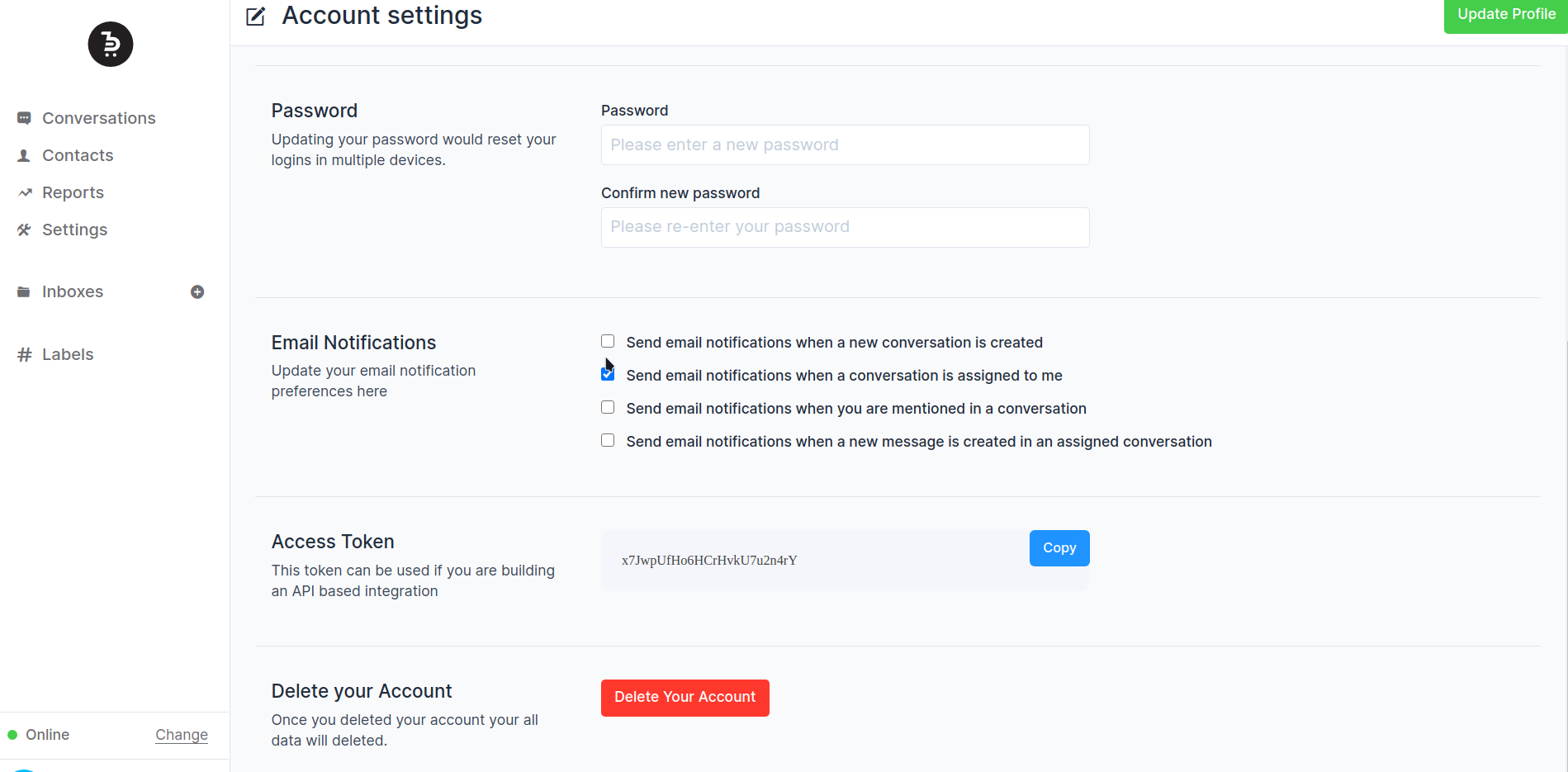
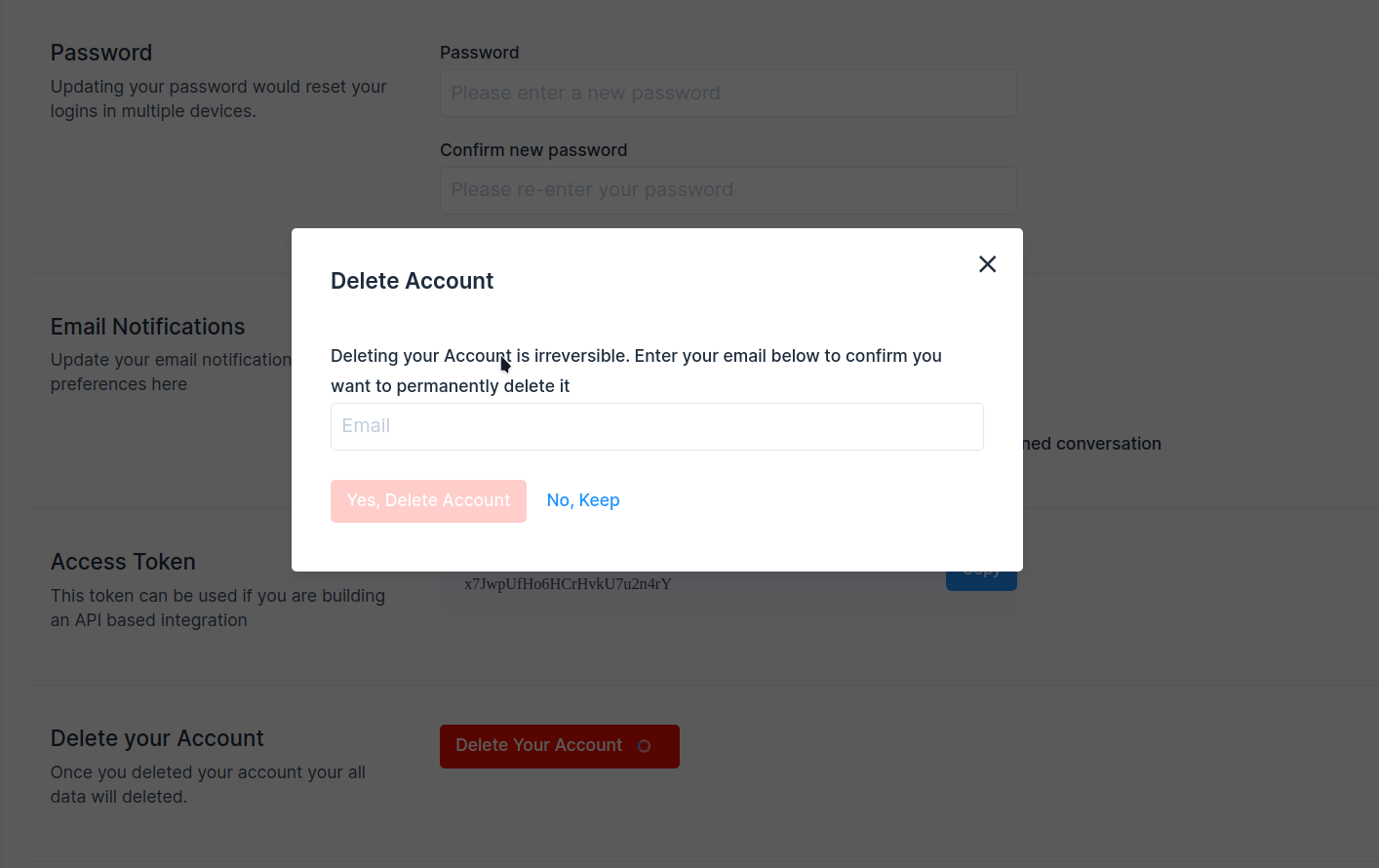
## Description
Add account delete option in the user account settings.
Fixes#1555
## Type of change
- [ ] New feature (non-breaking change which adds functionality)
## Checklist:
- [ ] My code follows the style guidelines of this project
- [ ] I have performed a self-review of my own code
- [ ] I have commented on my code, particularly in hard-to-understand
areas
- [ ] I have made corresponding changes to the documentation
- [ ] My changes generate no new warnings
- [ ] I have added tests that prove my fix is effective or that my
feature works
- [ ] New and existing unit tests pass locally with my changes
- [ ] Any dependent changes have been merged and published in downstream
modules
---------
Co-authored-by: Sojan Jose <sojan@pepalo.com>
Co-authored-by: Sojan Jose <sojan.official@gmail.com>
Co-authored-by: Muhsin Keloth <muhsinkeramam@gmail.com>
- Add a job to remove stale contacts and contact_inboxes across all accounts

Stale anonymous contact is defined as
- have no identification (email, phone_number, and identifier are NULL)
- have no conversations
- are older than 30 days

---------

Co-authored-by: Pranav <pranav@chatwoot.com>
Co-authored-by: Shivam Mishra <scm.mymail@gmail.com>
- Twilio events were being processed synchronously, leading to slow API
responses.
- This change moves Twilio event processing to a background job to
improve performance and align with how other events (e.g., WhatsApp) are
handled.

---------

Co-authored-by: Pranav <pranav@chatwoot.com>