fixes: #11834

This pull request introduces TikTok channel integration, enabling users
to connect and manage TikTok business accounts similarly to other
supported social channels. The changes span backend API endpoints,
authentication helpers, webhook handling, configuration, and frontend
components to support TikTok as a first-class channel.


**Key Notes**
* This integration is only compatible with TikTok Business Accounts
* Special permissions are required to access the TikTok [Business
Messaging
API](https://business-api.tiktok.com/portal/docs?id=1832183871604753).
* The Business Messaging API is region-restricted and is currently
unavailable to users in the EU.
* Only TEXT, IMAGE, and POST_SHARE messages are currently supported due
to limitations in the TikTok Business Messaging API
* A message will be successfully sent only if it contains text alone or
one image attachment. Messages with multiple attachments or those
combining text and attachments will fail and receive a descriptive error
status.
* Messages sent directly from the TikTok App will be synced into the
system
* Initiating a new conversation from the system is not permitted due to
limitations from the TikTok Business Messaging API.


**Backend: TikTok Channel Integration**

* Added `Api::V1::Accounts::Tiktok::AuthorizationsController` to handle
TikTok OAuth authorization initiation, returning the TikTok
authorization URL.
* Implemented `Tiktok::CallbacksController` to handle TikTok OAuth
callback, process authorization results, create or update channel/inbox,
and handle errors or denied scopes.
* Added `Webhooks::TiktokController` to receive and verify TikTok
webhook events, including signature verification and event dispatching.
* Created `Tiktok::IntegrationHelper` module for JWT-based token
generation and verification for secure TikTok OAuth state management.

**Configuration and Feature Flags**

* Added TikTok app credentials (`TIKTOK_APP_ID`, `TIKTOK_APP_SECRET`) to
allowed configs and app config, and registered TikTok as a feature in
the super admin features YAML.
[[1]](diffhunk://#diff-5e46e1d248631a1147521477d84a54f8ba6846ea21c61eca5f70042d960467f4R43)
[[2]](diffhunk://#diff-8bf37a019cab1dedea458c437bd93e34af1d6e22b1672b1d43ef6eaa4dcb7732R69)
[[3]](diffhunk://#diff-123164bea29f3c096b0d018702b090d5ae670760c729141bd4169a36f5f5c1caR74-R79)

**Frontend: TikTok Channel UI and Messaging Support**

* Added `TiktokChannel` API client for frontend TikTok authorization
requests.
* Updated channel icon mappings and tests to include TikTok
(`Channel::Tiktok`).
[[1]](diffhunk://#diff-b852739ed45def61218d581d0de1ba73f213f55570aa5eec52aaa08f380d0e16R16)
[[2]](diffhunk://#diff-3cd3ae32e94ef85f1f2c4435abf0775cc0614fb37ee25d97945cd51573ef199eR64-R69)
* Enabled TikTok as a supported channel in contact forms, channel
widgets, and feature toggles.
[[1]](diffhunk://#diff-ec59c85e1403aaed1a7de35971fe16b7033d5cd763be590903ebf8f1ca25a010R47)
[[2]](diffhunk://#diff-ec59c85e1403aaed1a7de35971fe16b7033d5cd763be590903ebf8f1ca25a010R69)
[[3]](diffhunk://#diff-725b90ca7e3a6837ec8291e9f57094f6a46b3ee00e598d16564f77f32cf354b0R26-R29)
[[4]](diffhunk://#diff-725b90ca7e3a6837ec8291e9f57094f6a46b3ee00e598d16564f77f32cf354b0R51-R54)
[[5]](diffhunk://#diff-725b90ca7e3a6837ec8291e9f57094f6a46b3ee00e598d16564f77f32cf354b0R68)
* Updated message meta logic to support TikTok-specific message statuses
(sent, delivered, read).
[[1]](diffhunk://#diff-e41239cf8dda36c1bd1066dbb17588ae8868e56289072c74b3a6d7ef5abdd696R23)
[[2]](diffhunk://#diff-e41239cf8dda36c1bd1066dbb17588ae8868e56289072c74b3a6d7ef5abdd696L63-R65)
[[3]](diffhunk://#diff-e41239cf8dda36c1bd1066dbb17588ae8868e56289072c74b3a6d7ef5abdd696L81-R84)
[[4]](diffhunk://#diff-e41239cf8dda36c1bd1066dbb17588ae8868e56289072c74b3a6d7ef5abdd696L103-R107)
* Added support for embedded message attachments (e.g., TikTok embeds)
with a new `EmbedBubble` component and updated message rendering logic.
[[1]](diffhunk://#diff-c3d701caf27d9c31e200c6143c11a11b9d8826f78aa2ce5aa107470e6fdb9d7fR31)
[[2]](diffhunk://#diff-047859f9368a46d6d20177df7d6d623768488ecc38a5b1e284f958fad49add68R1-R19)
[[3]](diffhunk://#diff-c3d701caf27d9c31e200c6143c11a11b9d8826f78aa2ce5aa107470e6fdb9d7fR316)
[[4]](diffhunk://#diff-cbc85e7c4c8d56f2a847d0b01cd48ef36e5f87b43023bff0520fdfc707283085R52)
* Adjusted reply policy and UI messaging for TikTok's 48-hour reply
window.
[[1]](diffhunk://#diff-0d691f6a983bd89502f91253ecf22e871314545d1e3d3b106fbfc76bf6d8e1c7R208-R210)
[[2]](diffhunk://#diff-0d691f6a983bd89502f91253ecf22e871314545d1e3d3b106fbfc76bf6d8e1c7R224-R226)

These changes collectively enable end-to-end TikTok channel support,
from configuration and OAuth flow to webhook processing and frontend
message handling.


------------

# TikTok App Setup & Configuration
1. Grant access to the Business Messaging API
([Documentation](https://business-api.tiktok.com/portal/docs?id=1832184145137922))
2. Set the app authorization redirect URL to
`https://FRONTEND_URL/tiktok/callback`
3. Update the installation config with TikTok App ID and Secret
4. Create a Business Messaging Webhook configuration and set the
callback url to `https://FRONTEND_URL/webhooks/tiktok`
([Documentation](https://business-api.tiktok.com/portal/docs?id=1832190670631937))
. You can do this by calling
`Tiktok::AuthClient.update_webhook_callback` from rails console once you
finish Tiktok channel configuration in super admin ( will be automated
in future )
5. Enable TikTok channel feature in an account

---------

Co-authored-by: Sojan Jose <sojan@pepalo.com>
Co-authored-by: iamsivin <iamsivin@gmail.com>
We’ve been watching Sidekiq workers climb from ~600 MB at boot to
1.4–1.5 GB after an hour whenever attachment-heavy jobs run. This PR is
an experiment to curb that growth by streaming attachments instead of
loading the whole blob into Ruby: reply-mailer inline attachments,
Telegram uploads, and audio transcriptions now read/write in chunks. If
this keeps RSS stable in production we’ll keep it; otherwise we’ll roll
it back and keep digging
Previously, email replies were handled inside workers. There was no
execution logs. This meant if emails silently failed (as reported by a
customer), we had no way to trace where the issue happened, the only
assumption was “no error = mail sent.”

By moving email handling into jobs, we now have proper execution logs
for each attempt. This makes it easier to debug delivery issues and
would have better visibility when investigating customer reports.

Fixes
https://linear.app/chatwoot/issue/CW-5538/emails-are-not-sentdelivered-to-the-contact

---------

Co-authored-by: Sojan Jose <sojan@pepalo.com>
Co-authored-by: Shivam Mishra <scm.mymail@gmail.com>
# Pull Request Template

## Description

Fixes
[CW-4620](https://linear.app/chatwoot/issue/CW-4620/rethinking-custom-domains-in-chatwoot)

<img width="642" height="187" alt="Screenshot 2025-07-29 at 8 17 44 PM"
src="https://github.com/user-attachments/assets/ad2f5dac-4b27-4dce-93ca-6cbba74443fb"
/>


## Type of change

- [x] New feature (non-breaking change which adds functionality)

## How Has This Been Tested?


## Checklist:

- [x] My code follows the style guidelines of this project
- [x] I have performed a self-review of my code
- [x] I have commented on my code, particularly in hard-to-understand
areas
- [ ] I have made corresponding changes to the documentation
- [x] My changes generate no new warnings
- [x] I have added tests that prove my fix is effective or that my
feature works
- [x] New and existing unit tests pass locally with my changes
- [ ] Any dependent changes have been merged and published in downstream
modules

---------

Co-authored-by: Vishnu Narayanan <iamwishnu@gmail.com>
Co-authored-by: Pranav <pranavrajs@gmail.com>
Co-authored-by: Pranav <pranav@chatwoot.com>
- Automate the deletion of accounts that have requested deletion via
account settings.
- Add a Sidekiq job that runs daily to find accounts that have requested
deletion and have passed the 7-day window.
- This job deletes the account and then soft-deletes users if they do
not belong to any other account.
- This job also sends an email to the Chatwoot instance admin for
compliance purposes.
- The Chatwoot instance admin's email is configurable via the
`CHATWOOT_INSTANCE_ADMIN_EMAIL` global config.

---------

Co-authored-by: Sojan Jose <sojan@pepalo.com>
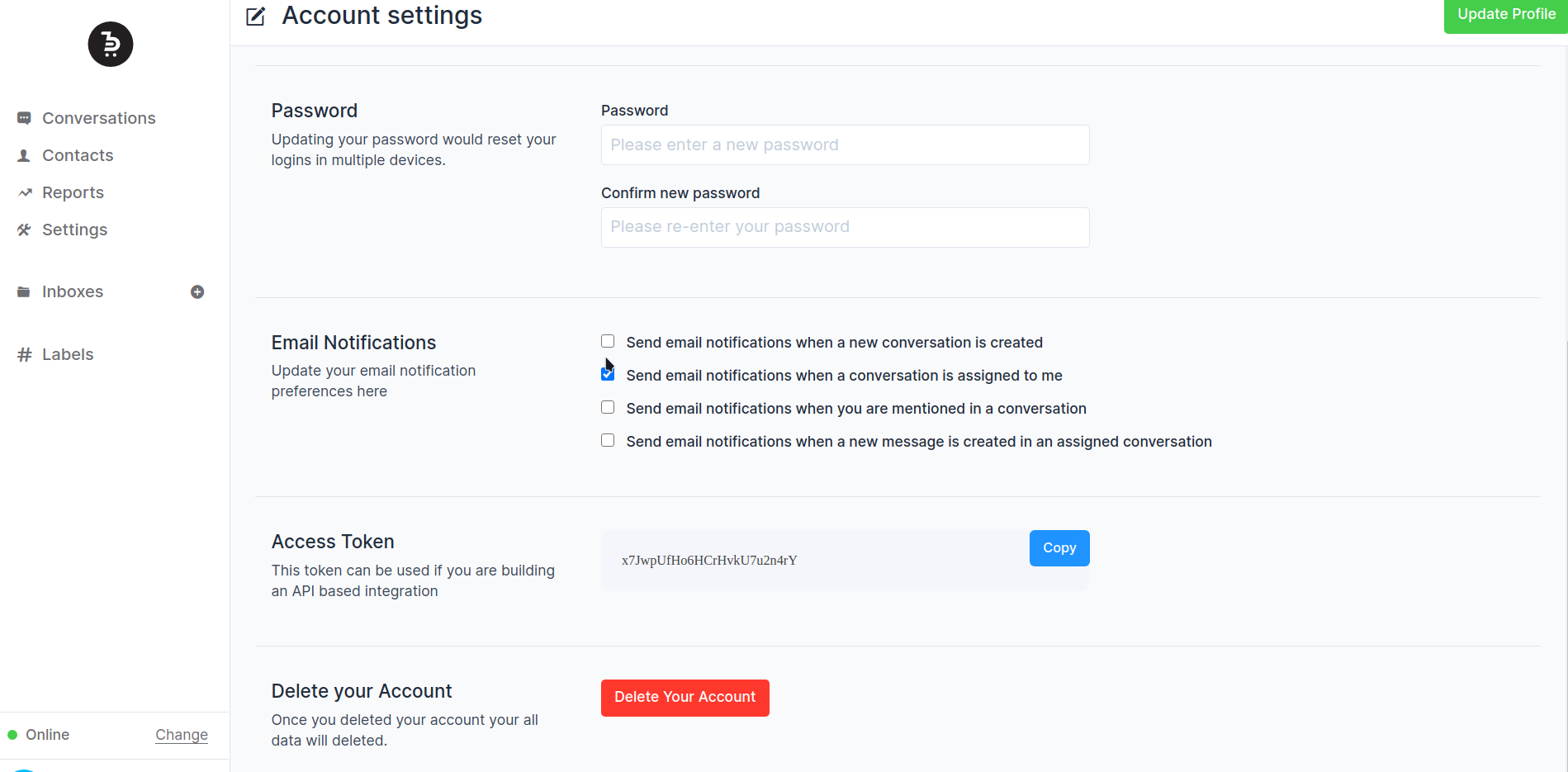
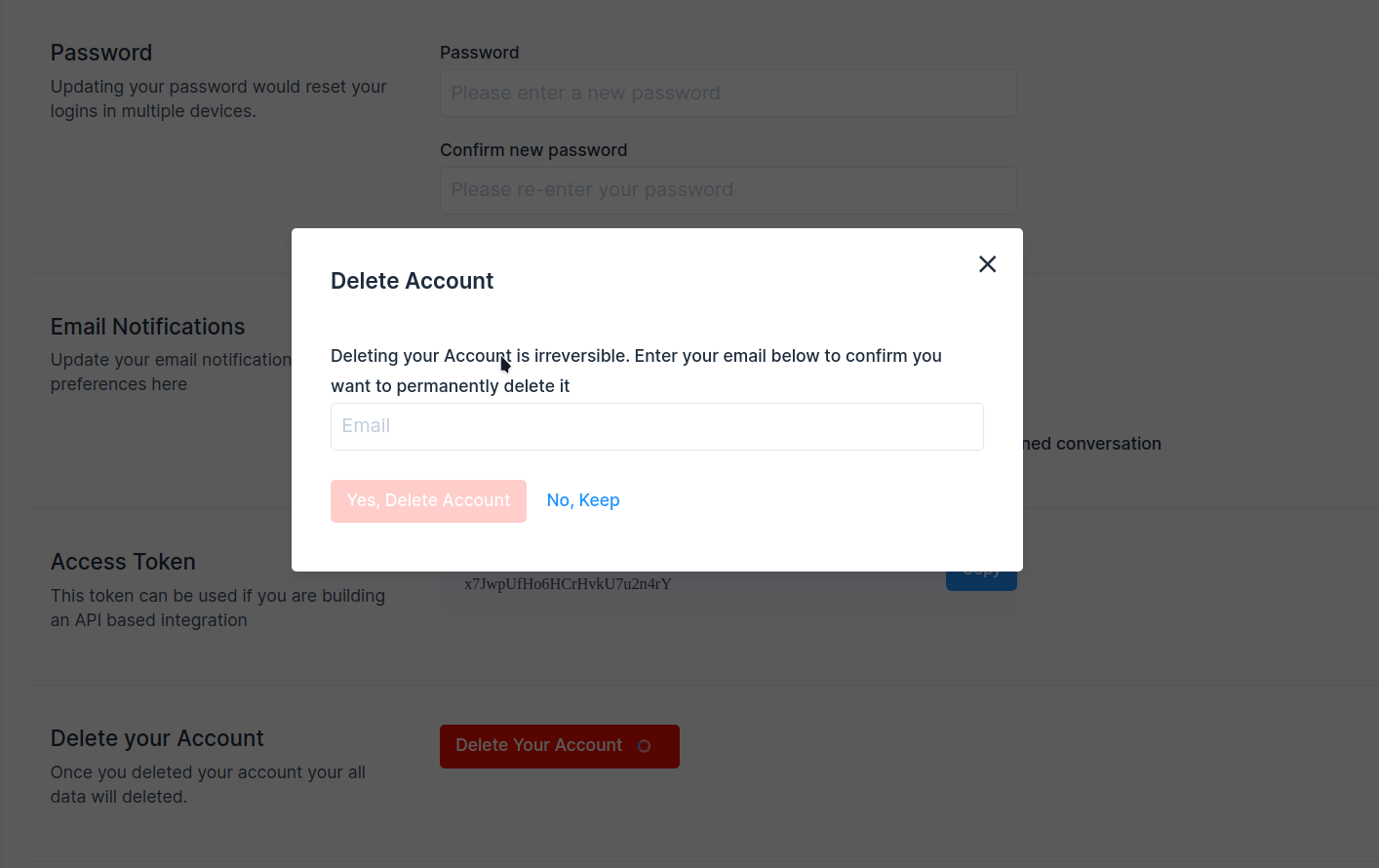
## Description
Add account delete option in the user account settings.
Fixes#1555
## Type of change
- [ ] New feature (non-breaking change which adds functionality)
## Checklist:
- [ ] My code follows the style guidelines of this project
- [ ] I have performed a self-review of my own code
- [ ] I have commented on my code, particularly in hard-to-understand
areas
- [ ] I have made corresponding changes to the documentation
- [ ] My changes generate no new warnings
- [ ] I have added tests that prove my fix is effective or that my
feature works
- [ ] New and existing unit tests pass locally with my changes
- [ ] Any dependent changes have been merged and published in downstream
modules
---------
Co-authored-by: Sojan Jose <sojan@pepalo.com>
Co-authored-by: Sojan Jose <sojan.official@gmail.com>
Co-authored-by: Muhsin Keloth <muhsinkeramam@gmail.com>
This pull request enhances the export contacts feature by adding a confirmation step before exporting. Previously, clicking the export button would trigger the export action without confirmation.

Additionally, it ensures that only the intended recipient receives the export email, addressing the previous behaviour where all administrators received it.

Fixes: #8504

Co-authored-by: Sojan Jose <sojan@pepalo.com>
- Ensure existing contact information is updated on data import
- Refactor the existing job to make it more readable
- Fixes issues with import files in the wrong encoding
fixes: #7307
We have display_name and the actual name for an agent. display_name is used in all public facing parts. The https://github.com/chatwoot/chatwoot/pull/7232/files PR missed this and used actual name instead.

This PR fixes it.
* chore: update to ruby 3.1.3

* chore: ping docker version to alpine3.16 for nodev16.x

Starting with Node 17, nodejs switched to OpenSSL3. The docker builds
are installing node18.xx with alpine-3.1.3.

From Node.js 17's announcement post:

    If you hit an ERR_OSSL_EVP_UNSUPPORTED error in your application
with Node.js 17, it’s likely that your application or a module you’re
using is attempting to use an algorithm or key size which is no longer
allowed by default with OpenSSL 3.0. A new command-line option,
--openssl-legacy-provider, has been added to revert to the legacy
provider as a temporary workaround for these tightened restrictions.

Looks like a webpack issue. This is fixed in webpacl 5+ and we are on
webpack4 at the moment.
Solutions

    Upgrade webpack.
    Pin nodejs version to be 16.x.x
    Use  --openssl-legacy-provider as a workaround.

Pin docker version to alpine3.16 branch to have node16.x by default

ref:
https://github.com/chatwoot/chatwoot/pull/5555#issuecomment-1379778532

* chore: update webmock

* chore: fix ruby gem path in dockerfile

* chore: switch to node16 in circleci

* chore: update ruby version in linux installer script

* chore: update ruby version in linux installer script

* chore: fix circleci

* chore: fix circleci

* feat: upgrade node version to 16.x in linux installer

* chore: update systemd files

Co-authored-by: Sojan Jose <sojan@chatwoot.com>
- Adds the backend APIs required for Microsoft Email Channels

Co-authored-by: Pranav Raj S <pranav@chatwoot.com>
Co-authored-by: Sojan <sojan@pepalo.com>